Friday, January 22, 2010

Review: Law Abiding Citizen (2009)


Released January 28, 2010


A lot of platitudes are thrown around in F. Gary Gray's new thriller, most of them by the psychopathic serial killer Clyde Shelton played by Gerard Butler. He voices fears about a judicial system more concerned with legal wrangling than with honest justice. You might sympathize with him for a little while, but less so after witnessing his alternative: the dismemberment of an alive but paralyzed victim, Saw style, one limb at a time.

Mercifully this occurs off screen, but it's not the only bit of nasty in this trashy mix of Silence of the Lambs and Seven that is nonetheless disturbingly entertaining thanks to a healthy dose of ludicrousness.

In the opening scene, Clyde's wife and daughter are killed and prosecutor Nick Rice (Jamie Foxx) makes a deal with the killers to ensure a sentence ("It's not what you know, but what can be proven in court," he says). Clyde is furious and directs his vengeance at the killers and system that let them off lightly. The twist is that he is imprisoned when the latter murders take place. How is he committing these crimes? Does he have an accomplice? And if so, who?

The final answer is as absurd as some of the gleefully over the top killings, which in the latter stages shift from torture porn malice to cheesy action movie clichés. The big moments are broadcast too early, too, making the surprise less about when and who, and more about how.

Despite all of this, Law Abiding Citizen is suspenseful and decently made. Foxx and Butler make adequate adversaries, with the latter particularly having fun with the lip-smacking sociopathic traits of his character. It would be interesting to wonder what the film may have been like if the lead actors switched roles, as has been intended when the project began. Little different I wager, if the script was still written by the creator of Equilibrium and Ultraviolet, Kurt Wimmer.

It’s the source of most of the movie’s problems, but also some of its pleasures. Any movie that has a vicious unprovoked murder with a t-bone has to have something going for it.


Friday, January 15, 2010

Review: In the Loop (2009)


Released January 21, 2010


After the film was over I felt dirty. It was as if all those hours of idealizing the policy makers of The West Wing were in vain. Is this what politics is really like?

The characters of In the Loop, a scathing political comedy, are either selfishly manipulative or clueless. In the former category are Brit spin doctor Malcolm Tucker (played with profane relish by Peter Capaldi) and American warmonger Linton Barwick (David Rasche). In the latter is the bumbling British MP Simon Foster (Tom Hollander), who mumbles suggestive platitudes about a possible war in the Middle East. "To walk the road of peace," he says, "sometimes we need to be ready to climb...the mountain...of conflict." This understandably ruffles Whitehall’s feathers, and soon he finds himself a pawn in a trans-Atlantic game to justify a war. Iraq is never named, but the allegory is plain.

Anna Chlumsky (My Girl, all grown up) shows admirable comedic chops as an assistant in Washington who is wooed by Foster’s aide Toby (Chris Addison). And a deadpan Gina McKee plays the British Director of Communications, one of the few characters with a modicum of sense, and hence is always hilariously on the receiving end of Tucker’s venom.

Director Armando Iaannucci has adapted his BBC series The Thick of It, drawn upon the zaniness of Dr. Strangelove and blended it with the pseudo-documentary style of The Office to craft one of the most entertaining and timely political satires in years.

It’s also utterly hysterical, with dozens of throwaway one liners that also offer sly observation. Hollander is a lovable fumbling klutz and a good foil for Capaldi. When asked his opinion in a Washington committee meeting all he can muster is that it is “difficult, difficult, lemon, difficult." You have to at least admire his honesty.

Born from the Bush era of politics, In the Loop is an apt reminder of how easy it is for those in power to misuse it for their own selfish ends. All those hours of The West Wing may not have been in vain, but even the most idealistic need a reality check once in a while.


Wednesday, January 13, 2010

Interview: Armando Iannucci


In The Thick Of It with the writer/director of In the Loop


Timely in its investigation of Bush-era politics, In the Loop is to the current climate as Dr. Strangelove was to the Cold War. As bitingly funny, though distinctly more foul mouthed, Loop is a scathing political satire about the invention of a phony justificaiton for war in the Middle East and the accompanying PR minefield.

Though it features a handful of relatively unknown actors (and some, James Gandolfini, aka. Tony Soprano, known), one could be forgiven for feeling the events on screen have been invented for our comedic pleasure. Consider especially the profanity-addicted New Labour spin-doctor Malcolm Tucker, played by Peter Capaldi, who prowls the corridors of Whitehall and Washington searching for his next victim. The most memorable and over the top character of the film, he is nonetheless based (albeit loosely) on Tony Blair’s right hand man, Alastair Campbell.

He’s not the only element drawn from fact, says co-writer/director Armando Iannucci, “I went to Washington and spoke to people who’d worked in the State Department, The Pentagon, CIA, United Nations and I came back with stories that we put in the film. That whole thing about the committee, the “future planning committee”, was true. Dick Cheney set up the Office of Future Plans, which was about looking into invading Syria and Iran”.

It’s this banal way in which major political and military decisions are made that makes the comedy of In the Loop so effective, an all too close-to-home perspective on a post 9-11 world still in recuperation. This kind of portrayal was important for Armando, “Well you know I haven’t seen Washington portrayed like that. I’ve seen it as sort of sinister and malicious or as being virtuous and heroic but not as being a bit rubbish and dysfunctional.”

The uneasy feeling of reality is complemented by the hand-held documentary style. David Stratton was severe in his criticism of this approach, but it was critical in achieving the feeling of eavesdropping on unfolding events. It also lends itself to the specific mix of script and improvisation. “I tend to shoot a lot. The script is 200 pages, and we shoot about 30 to 40 pages a day, because I just want to get the franticness, so the cast doesn’t have too much time to learn how they’re going to perform something so that it feels spontaneous.”


Two cameras were used at once with flexible lighting setups, enabling the actors to roam where they pleased. The improvisations, though, proved a challenge for the cast, “Well some of them were used to it because they’ve done the TV show and others were a bit more wary. It’s quite a tall order to ask of someone, to try and be coherent, funny, literary, persuasive, all at the same time. Occasionally you write extra bits of dialogue to give to one cast member and give it to them separately so they can just throw it in to see how the others react. Because sometimes what’s funny is not so much the line but the shocked look on someone’s face as they say it for the first time”.

Frequently, what was envisaged as a tent-pole scene became less important than small improvised moments. “Simon Foster is eventually at the committee meeting and is asked his view and all he can think of is "difficult difficult, lemon difficult". We made that up at the end of the day, that line. Again that’s a line that people quote afterwards, but that wasn’t even in the script when we were shooting”.

Armando is used to this style of shooting, having a wealth of experience in UK television and radio. He was a writer on I’m Alan Partridge (which partly explains Steve Coogan’s appearance as collapsing-wall-Paul) and created The Thick of It, the series on which In the Loop is based. Initially it was not his intention to follow on from the TV show, but with a desire to branch out into film and still focus on his political comedy strengths, it became the most practical choice, “I was already doing The Thick of It. I thought well I’ve got that world, we’ve already got some of the characters there, like Malcolm Tucker. So that was the thinking, to apply that to a bigger story.”

The reception, upon its premiere at Sundance, was better than he could have expected, “I hadn’t actually seen it with an audience before, an American audience. Then they started laughing and I was relieved and it got a great reaction. I think a lot of them found it slightly therapeutic, just after George Bush. It was there chance to see it up on screen.”

The reaction from politicians was no less positive, if a bit more cagey. “Though it’s a comedy, you know I wanted to get it right. I wanted to get the authenticity and some of the detail right. It came out in the States in July and there was a screening in Washington and we invited a lot of Washington insiders, and they laughed all the way through. At the end someone put their hand up and said “can we just apologize?”.

In the UK, “Politicians, publicly, hate it. But quietly they say ‘How on Earth did you find out?’”.

For Iannucci's film, there can be no greater compliment.

In the Loop is released in Australia on January 21.

The full transcript of this interview can be found here.

Wednesday, January 6, 2010

Review: Up in the Air (2009)


Released January 7, 2010


No film has better captured the confusion and alienation of the post Bush-era recession than Jason Reitman’s latest, a sly and poignant study of a man who goes everywhere and nowhere.

He is Ryan Bingham (George Clooney). You know the type. Smart suit, smooth talking, efficient but empty. He lives in an airport lounge, travelling across the country firing people for a living. Sometimes he gives motivational speeches, extolling the virtues of living an attachment free life. If the sum of your relationships and possessions were a backpack, he says, his would be empty. And he wants yours to be too.

But his boss (Jason Bateman) is about to take him off the road. He is to be replaced by a more efficient iPhone-generation firing system suggested by the ambitious but inexperienced Natalie (a wonderfully zestful Anna Kendrick). In a last ditch effort to maintain his lifestyle, Ryan takes Natalie on the road to show her what firing people is really like.

Bingham ends up learning as much from her as she does from him, though his real muse is the seductive Alex (Vera Farmiga, The Departed). With her he finds a kindred spirit, and for the first time considers whether there are things more important than his dream of obtaining 10 million frequent flyer miles.

The story could have easily slipped into romantic comedy clichés (and, despite its often profound subject matter, it is very funny), but Reitman, who also co-wrote the screenplay from Walter Kim’s novel, is too clever for that. Underneath the witty banter and screwball comedy sensibility, there’s a humbling and sad realization about life in the technological age. The reality is amplified by scenes involving real people describing their anguish, fear, and uncertainty following the widespread layoff of staff.

Clooney has never been better, still the smooth charmer he’s always been, and Farmiga and Kendrick are his match. Jason Reitman has already made the excellent Thankyou for Smoking and Juno. With Up in the Air he’s topped them both. A.O. Scott called it “a classic in the making”. He’s not wrong.


Monday, January 4, 2010

Review: Bran Nue Dae (2009)


Released January 14, 2010


Excluding Sweeney Todd and its more sophisticated brethren, movie musicals have, traditionally, been a place for escapist, joyous entertainment. Think Astaire and Rogers, Gene Kelly or even Baz Luhrmann’s opulent Moulin Rouge. Rachel Perkins' new film, with a distinctly Australian flourish, strives but fails to achieve this same level of immersive fantasy.

Lurching incoherently from one musical number and moments of attempted humour to the next, we follow Willie (Rocky McKenzie), an Indigenous teenager sent to a Catholic Mission in Perth from his home in Broome. Not appreciating the strict rules imposed by the nasty Father Benedictus (a game Geoffrey Rush), and keen to declare his love for Rosie (Jessica Mauboy), he flees back home towards the inevitable road movie on the horizon.

Road movies work when the episodic escapades enlighten our heroes on their journey of discovery. It helps if they are entertaining. This was true of the far superior, and similarly themed, Stone Bros. Here, it’s not. If it’s not Magda Szubanski’s sleazy Roadhouse owner causing us to roll our eyes, it’s the unconvincing acting and ramshackle story telling. It’s ironic that a film so gleefully pleading for tolerance is populated by painful clichés such as the combie van hippies who offer our insipid hero and his drunk mentor, Uncle Tadpole (Erine Dingo), a ride north.

Still, a musical lives or dies on the success of its musical numbers, which are frequent but random and forgettable. Neither enhancing character nor forwarding the plot, they exist only to add vapid colour and energy. And somehow, despite this exuberance, Bran Nue Dae manages to bore. This is especially so in the absurd finale which involves more twists and reversals than the third Pirates of the Caribbean. By that point I wished I could borrow Szubanski’s .303 rifle to extract myself from the misery.

Bran Nue Day’s greatest asset is the gorgeous cinematography from Lord of the RingsAndrew Lesnie. I can only give the original writers of the 1990 stage musical the benefit of the doubt that much has been lost in translation.


Monday, December 21, 2009

Heat (1995)


Blu-ray released October 27, 2009

Robert De Niro and Val Kilmer shoot up L.A in Heat

"Don't let yourself get attached to anything you are not willing to walk out on in 30 seconds flat if you feel the heat around the corner."

That’s Robert De Niro’s Neil McCauley, a professional thief leading an insular life in Michael Mann’s 1995 crime classic, Heat. It’s the kind of attitude you need when your idea of a good time is driving a truck into an armoured car to steal 1.6 million dollars. Especially when a rouge member of your team, Waingro (Kevin Gage), murders one of the guards, necessitating killing the other two to avoid leaving witnesses.

McCauley’s philosophy is his self-preservation mechanism, designed to prevent his capture and imprisonment. That is, however, what the tough snap-at-any-moment cop, Vincent Hanna, played by Al Pacino, most desires. He, like McCauley, is equally detached from others. He prefers to keep company with the criminals he hunts so obsessively. This pleases neither his wife, Justine (Diane Venora), nor his attention deprived step-daughter (Natalie Portman, in her second film).

McCauley, despite knowing Hanna is monitoring their every move, subsequently plans a 12 million dollar heist in Downtown L.A. This sets the scene for a phenomenal extended action sequence. Its virtuosity is in its technicality: the way Mann shoots it with frequent POV shots, Elliot Goldenthal spare percussive musical score. It’s cold, epic and brutal with a grim sense of reality. It’s here that Blu-ray comes into its own, with the thunderous automatic weapon fire rattling all 5.1 channels.

But though it may have been marketed as one, Heat is no action picture. It is instead a layered portrait of two men on either side of the law, both trying and failing to have it all. It deals specifically with their relationship to their women: Hanna to Justine, McCauley to his new girlfriend Eady (Amy Brenneman), and Chris (Val Kilmer), another member of McCauley’s team, to Charlene (Ashley Judd). They try but fail, the most long lasting kinship developing between the two lead adversaries.
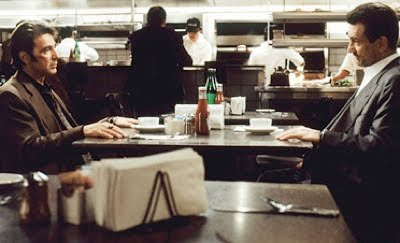

Clash of the Titans

It’s perverse that Mann casts two megastars and yet keeps them apart bar one central scene. Taking a break from pursuing each other, Hanna and McCauley stop at a coffee shop and discuss each other in matter-of-fact, detached words. By their own admission, they are two sides of the same coin.

Heat is epic. Not in the same way as The Lord of the Rings or Lawrence of Arabia, but epic in the scope of its depiction of the cops and robbers circulating the underbelly of Los Angeles. There are at least half a dozen more significant characters that flesh out the world, including William Fichtner as an out-of-his-depth businessman and Jon Voight as one of McCauley’s few trusted associates, but the one that looms largest is the city itself. It’s an L.A. of greys and blues, one where the line between good and evil is not clearly defined.

While it’s disappointing that this release has no Blu-ray specific special features – they are the same that featured on the 2-disc DVD – they themselves are excellent. There’s a commentary by Mann, which is not wall-to-wall but interesting, eleven deleted scenes and five documentaries. The featurettes are a mixture of 1995 interviews and retrospectives created around the time of the release of the original DVD. There’s about an hour worth of material, the best of which are “Crime Stories” and “Into the Fire”, which give an in depth discussion of the film’s long gestation period (Mann couldn’t get it financed until shooting a TV movie on the same subject called L.A. Takedown), training the cast to use automatic weapons, shooting the climactic battle and the choice of soundtrack. Much of the cast and crew, including Mann, De Niro, Pacino, Kilmer, Judd and Tom Sizemore are interviewed. These extras are unsurprisingly presented in full-frame SD.

The quality of the feature presentation is, however, splendid and a perfect match of Mann’s uncomplicated style. The washed out cold tones don’t leap out at you as some other, more flashy films, but it’s beautiful and understated, a perfect reflection of the characters and of a Los Angeles divorced from its typical sunny, Hollywood image. It’s this layered depiction of the city and its two damaged protagonists that elevate what could have easily been a simplistic heist movie. Heat is a modern classic.


Friday, December 18, 2009

Sherlock Holmes (2009)


Released December 26, 2009


Robert Downey Jr.’s version of the famous detective is a dishevelled manic-depressive just as likely to outwit you with his fists as he is his brain. There’s not a deerstalker in sight. Berating modern Hollywood for turning him into an action hero and expanding the story to mythic superhero-like proportions will only prevent you from enjoying one the most purely fun entertainments of the year.

To be fair, many of the elements foregrounded in Guy Richie’s blockbuster are, at least peripherally, drawn from the original stories. Holmes was a trained boxer and a talented bare-knuckle fighter, a trait played up in a delicious blend of Richie’s hyper-kinetic slow motion and Holmes renowned deductive skill as he prefigures the exact blows and injuries necessary to incapacitate an opponent. He was fiercely intelligent and an occasional drug user. He did have little regard for the tidiness of his flat (which is littered with papers, trinkets and half-built inventions), and he was not exactly highly skilled in social situations. For that, he required the more sensible and grounded Dr. Watson. In this incarnation he is played by Jude Law and is more of an equal than an assistant. Their banter, energetically delivered by the two stars, forms the heart of the film.

We open with a tremendous action sequence, accompanied by a thunderously superb Hans Zimmer score, in which our heroes try to prevent the villainous Lord Blackwood (Mark Strong) from completing a ritual sacrifice. Holmes is drawn out from his subsequent drug-induced slumber when it appears Blackwood, hanged for his crimes, has risen from the grave and is countinuing his meddlings in black magic and the occult. Blackwood’s scheme rivals that of a Bond villain, though the real mastermind lurks ominously in the shadows. At least, that is, until the sequel.

While there is one extravagant set piece too many, the pace is brisk, the action clever and the CGI evocation of Victorian London stylish. Like Ironman, though, Holmes belongs to Downey Jr., his flippant but layered take on the sophisticated sleuth surely to be added to the Jeremy Brett and Basil Rathebone pantheon.


.rating_bar { width: 55px; background: url(https://blogger.googleusercontent.com/img/b/R29vZ2xl/AVvXsEg9XP_SRQ0Dq2a7j99mUHLCfioyZigWdOVEoinlChLBCS2ug7MNaZ2x4jWFn3xWHs9p7b02VrzQVlKjHAPZy2gsfsEly2UTw3bGAQ8IshkWmutEFzB1fDxYKiPYl5qaocFTYAlGCGyIuip8/s400/star_x_grey.gif) 0 0 repeat-x; } .rating_bar div { height: 12px; background: url(https://blogger.googleusercontent.com/img/b/R29vZ2xl/AVvXsEg9XP_SRQ0Dq2a7j99mUHLCfioyZigWdOVEoinlChLBCS2ug7MNaZ2x4jWFn3xWHs9p7b02VrzQVlKjHAPZy2gsfsEly2UTw3bGAQ8IshkWmutEFzB1fDxYKiPYl5qaocFTYAlGCGyIuip8/s400/star_x_orange.gif) 0 0 repeat-x; }